Thursday, 11 April 2019

Usability Testing in Singapore

No matter how good the idea is or how good the model is, one cannot be sure about it until they test it. The best way to test it, of course, is to test on the person. If the person likes the model, and the model goes smoothly on the real situation; the product is well-made and successful. If the product is not up to the satisfaction of the customer, it fails. That is where the concept of the usability testing comes in. Usability testing is a simple test of how easy the product is for the real users for user experience.
On the process of the testing, users are asked to test a product in front of the researchers. During the process of the research, if the users are found to have trouble on the certain aspect of the product, then it will be notified to the company to fix that following issue. This test will be conducted continuously until it is deemed that the product is easy to use for the customer at the end. The ending goal of the user testing is for the users to feel that the product is usable and intuitive, and it must also be accessible for the users as well.
There are numerous ways to test the product. Another way of testing the product, other than the usability testing, is the traditional testing. Traditional testing is simply a continuous test conducted by the developer, designer, and managers through computer screening and coding. It is possible that the testing can have bias as well as fault within the testing. The simple bug testing and function testing will not be able to truly cover whether the customers will be satisfied with the product. It also cannot fix the accessibility for the customers. No bug within the program does not mean that the product can easily be used by the users. Therefore, the best way for the company to conduct testing is through the usability testing.
Not only is the usability testing important, the company that is conducting the test is also important. One of the most recommended company to conduct the usability testing within Singapore is the USER Experience. USER Experience is a company based in Singapore. It has years of experience on the usability testing with numerous companies. It has worked with the Singapore Ministry of Education, Samsung, Paypal, Universities, and hp. With more than decades of experience, it is one of the most trusted company in Singapore to conduct the usability testing. It starts the testing from users all the way to the experts testing the product. It is carefully and precisely conducted so that the final product can come out as above and beyond the customer’s satisfaction. With the professional team and accurate data collection, it is the top priority company to ask for the test to be conducted.

Wednesday, 27 March 2019

The well-kept secret behind great UX: Usability Testing

Hello world!
I am back as I promised. This time with a plan. A full proof plan on “how” rather than “why”. If you are not sure what I am saying, please check my previous blog post on Why is it important to do usability testing?
Ready?
Let’s roll.

Preparing a test plan

The first step is to create a test plan. It is a very important step to determine what we are testing, what we are going to give to our users. Before preparing a test plan we need to:
  • Define what areas to concentrate on
  • Determine potential usability issues
  • Write a test plan
  • Determine what tasks will be tested

A Test plan should include

  1. Objective
  2. Test task (scenario)
  3. End state (answers)
Well-formed task scenarios make smoother tests. Write the test tasks so that users feel motivated to perform the scenario and do not just take it up as a “to-do” list.
Sequence the task in the order of easy (orientation tasks), difficult and moderate so that users don’t get frustrated at the beginning of the test. This can happen in case they face any difficulty in understanding their role.

Interact with participants before test starts

  • Explain to your participants that the objective is to test the software and not the participants’ intelligence. This is important as the participants may feel that their ability is being tested.
  • Explain how the test material and record will be used
  • Encourage participants to think aloud while using the product
  • Prepare a pre-test questionnaire and a post-test questionnaire

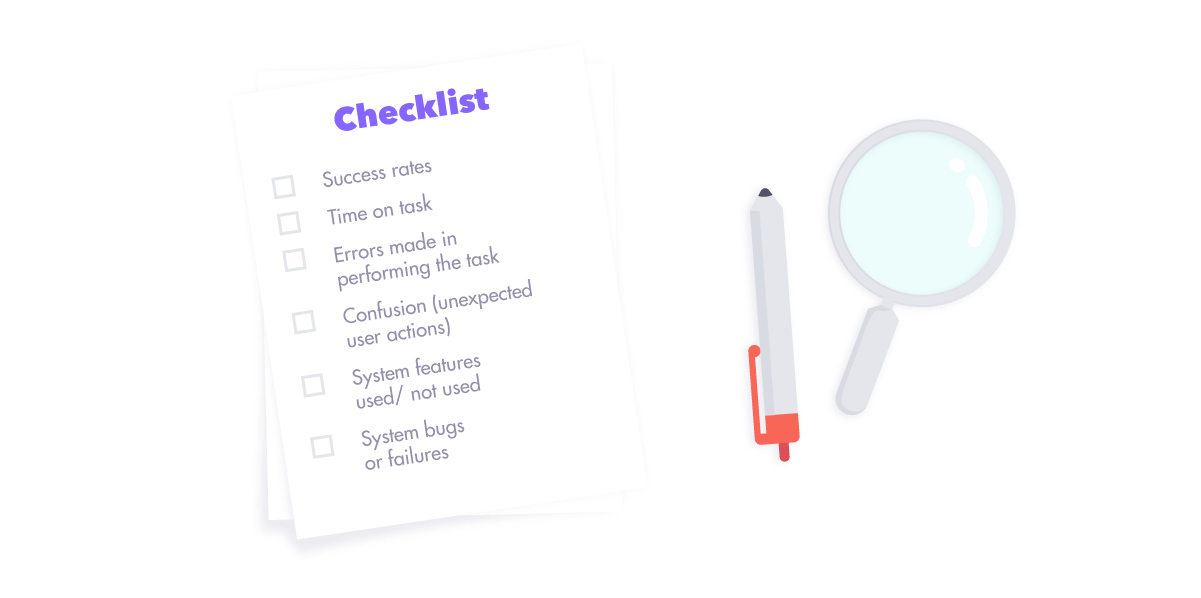
Prepare a checklist for Usability Testing


  • Success rates
  • Time on task
  • Errors made in performing the task
  • Confusion(unexpected user actions)
  • System features used / not used
  • System bugs or failures

During the test

  • Record techniques and search patterns participants employ when attempting to work through a difficulty, for recording we can use software like ScreenFlow or silverback (mac only) of user testing.
  • If participants are thinking aloud, record assumptions and inferences being made.
  • Do not interrupt participants unless absolutely necessary
  • If participants need help, provide some responses-
Provide encouragement or hint
Give general hints before specific hints
Record the number of hints given
  • Watch carefully for the signs of stress in participants-
Sitting for a long time doing nothing
Blaming themselves for the problems
Flipping through documentation without really reading them
  • Provide short breaks when needed
  • Maintain a positive attitude for user experience, no matter what happens
  • Use a monotone tonality with users i.e. never let users know that you are super excited or your body language indicate them that they are doing bad and things like that of usability testing.
  • In case users ask questions to try to get your consent if they are doing it right never give them direct answers instead use words like “Okay, uh huh”. Instead, ask reverse questions like “Is it what you were looking for”
  • Let them struggle and don’t over moderate

Tuesday, 12 March 2019

Website usability testing workflow in 6 steps

Having a good usability testing work flow in place can save you time so you can spend your time doing what you do best: designing. The process can be broken down into 6 steps:
Identify what you need to test and why you’re testing it
No test is going to go well if you don’t know what you’re looking for. Make sure to have a firm understanding of the scope of user experience. You might want to test the navigation flow of your site, the position of a call to action button or even just the web copy. Whatever you endeavor to test make note of it.

Know your audience

Who is your desired user?Knowing who your audience is will strengthen the design process and allow you to understand the parameters of your designs. By understanding your audience you can design better for them — why not look into empathy maps so you can really get into your user’s shoes?

Write a task list for users to go through

Guidelines are needed to help your users through the test. Presumably, you’ll have some goals in place that you want the user to achieve on your website. Maybe you want them to sign up to something or learn about the services you have on offer? Whatever the goal, write it down. These goals can then be turned into task scenarios which can encourage action from your users.

Find worthwhile participants to test

There are many usability tools out there which can help you find users to test. But, you really want to find participants who are your target audience, not strangers who are pretending to be your users. Using real life users is going to give you more accurate information that you can use as you iterate through the design process. Don’t forget that you can use the tools already integrated with Justinmind to get instant feedback.

Get stakeholders involved

With Justinmind’s powerful sharing capabilities, you can have all key stakeholders on the right page. When you invite them to your prototypes, you can give them the ability to leave comments on specific UI components. Having stakeholders engaged at this stage can align their wants and needs cohesively as the design process flourishes. For an even smoother website usability testing process, don’t neglect capturing UX requirements for usability testing.

Put your findings into practice

Now you can put all your learnings into practice by implementing your findings. You’ll have uncovered the errors (both critical and non-critical), understood the likes, dislikes and recommendations as well as how long tasks take on your website. Now all that’s left is to make the appropriate iterations to your interactive prototypes and get them sent off to production of user testing.

Monday, 11 March 2019

2 important lessons for user testing copy and language

Certainly, no research is easy. But it’s often less difficult to get immediate feedback on the way a web page or product looks or feels. Less quick is soliciting feedback on copy — and finding out what works or what doesn’t.
Traditionally, most design teams would approve copy like this: an editor will make sure it follows the tone of voice, then A/B test two different versions to see which works more. Sometimes a brand team might be involved.
Photo by @criene
There’s nothing… wrong with that per se. But it doesn’t necessarily provide you with specific feedback on which types of copy work, and why or why not. A/B testing that copy will give you a binary outcome: one works better than the other. But it could be missing blind spots where copy may confuse users, or may only be doing a good enough job.
You might even miss points where that copy is actively damaging your brand of user experience.
That’s where user testing language comes into play. Instead of an afterthought, copy questions and tasks should be designed from the very beginning — and they ought to be an intrinsic part of your testing process.
This is how you can do it.

The right words at the right time

One of the problems with A/B testing copy is that, while you get an overall result, you don’t get specific feedbook on what works, and what doesn’t.
For basic landing pages with very little content, like a form, this isn’t necessarily too big of a problem. But when you start developing pages that are designed to show detail and explain complex topics, like a product page or a feature page, understanding what phrasing works and why it works becomes so much more crucial.
“Not all types of user testing are created equal.”
Yet it’s also difficult. Users will often tell you explicitly why they don’t like something on a visual or interactive level, but most people are user testing worker. They can’t tell you why they don’t understand something.
So they’ll generally say things like, “I don’t get it.” Or “I don’t understand what this feature does.” That’s ambiguous and often vague, but extremely valuable. It means you know your copy isn’t doing the right job.
Now, if you had just done an A/B test? You’d never know that specific feedback. For many designers, copy testing isn’t a priority. They focus on the visual, on whether the CTAs are in the right place. But then ignore the copy that would make them want to click on the CTA in the first place for usability testing.
That’s a mistake.

5 Simple Tips to Improve User Testing

Testing is a fundamental part of the UX designer’s job and a core part of the overall UX design process. It’s a great way to eliminate problems or user difficulties that were unforeseen in the design phase.

1. Test As Early As You Can

The earlier you test, the easier it is to make changes and thus the greater impact the testing has on the eventual quality of the product.
Tips:
  • Don’t wait for a fully formed product— you can test design mock-ups and semi-functional prototypes (even low-fidelity ones) as long as you can explain to test participants what’s required from them.
  • Once you’ve defined which user tasks should be tested, start validate your design. You can embrace  user testing. When you have a prototype, step out of your office, find people who are at least similar to your target users and begin testing!

2. Outline Your Objectives For the Test

Be crystal clear on your goals. Make sure you only ask questions you need answered. Before starting usability testing, you’ll need to ask yourself:
“What do I need to know from this test?”
and then, once you understand what you need to know, you can write your questionnaire or survey with that objective in mind.

3. Ask Open-Ended Questions

Closed questions have a limited choice of answers. These may be binary (yes/no) or multiple choice. Open-ended questions let you discover things you never thought of and let you learn the language of customers.

4. Treat Design as a Dynamic Process

A lot of designers think about the design process as a linear process which starts with user research, has a phase of prototyping, and ends up with testing. However, it should be treated as a dynamic process.
Regular user feedback should be at the heart of   user experience process.
Testing, as much as coding, designing or gathering requirements, requires its intended place in the iterative loop of product design and development. It’s important to have user tests at each interval of this process if the resources are available.

5. Test With Real Users

Validate your design based on tests with real users. Ensure you test with users who aren’t only your friends or family! You need independent and unbiased users.
Tip: When it comes to UX testing, sometimes it’s important to start with the idea of a user in your worst case scenario (e.g. someone who knows nothing about your product, is distracted when they onboard, etc). By watching that person use your product, you can quickly identify areas where the app is not simple or clear enough.

Wednesday, 6 March 2019

Simple Tips to Improve User Testing

Testing is a fundamental part of the UX designer’s job and a core part of the overall UX design process. Testing provides the inspiration, guidance and validation that product teams need in order to design great products. That’s why the most effective teams make testing a habit.
Usability testing involves observing users as they use a product. It helps you find where users struggle and what they like. There are two ways to run a usability test:
  • Moderated, in which a moderator works with a test participant
  • Unmoderated, in which the test participant completes the test User 


  • User testing is a fundamental part of the UX designer’s job and a core part of the overall UX design process. Testing provides the inspiration, guidance and validation that product teams need in order to design great products. That’s why the most effective teams make testing a habit.
    Usability testing involves observing users as they use a product. It helps you find where users struggle and what they like. There are two ways to run a usability test:
    • Moderated, in which a moderator works with a test participant
    • Unmoderated, in which the test participant completes the test alone
    We’ll focus on the first, but some of the tips mentioned can be applied to both types of testing.

1. Test As Early As Possible

The earlier you test, the easier it is to make changes and, thus, the greater impact the testing will have on the quality of the product. A lot of design teams use the excuse, “The product isn’t done yet. We’ll test it later,” to postpone testing. Of course, we all want our work to be perfect, which is why we try to avoid showing a half-baked design. But if you work too long without a feedback loop, the chances are higher that you’ll need to make a significant change after releasing the product to the market. It’s the classic mistake: thinking you’re the user and designing for yourself. If you can invest energy to learn early and prevent problems from happening in the first place, you will save a tremendous amount of time later for usability testing.
The good news is that you don’t need to wait for a high-fidelity prototype or fully formed product to start testing. In fact, you should start testing ideas as soon as possible. You can test design mockups and low-fidelity prototypes. You’ll need to set the context for the test and explain to test participants what’s required of them.

2. Outline Your Objectives

Before starting usability testing, be crystal clear on your goals. Think of the reason you want to test the product. What are you trying to learn? Ask yourself, “What do I need to know from this session?” Then, once you understand that, identify exactly which features and areas you want feedback on.
Here are a few common objectives:
  • Find out whether users are able to complete specified tasks successfully (e.g. purchase a product, find information)
  • Identify how long it takes to complete specific tasks
  • Find out whether users are satisfied with a product and identify changes required to improve satisfaction


Thursday, 28 February 2019

6 TIPS FOR USABILITY TESTING

  1. Write a scriptHaving a script is handy to maintain consistency between interviews, and to help other members of your team follow along. It also allows you to build in unbiased questions at every step. I recommend printing out the script as a prompt and highlighting your questions so you hit the same key points with every user testing.
    *Don’t forget to ask permission to record the interview and share it with your team—I built this question into my script so I wouldn’t forget.
  2. Divide & conquer with emails Your teammates can help when it comes to randomly selecting users and editing your email template, and even better if you can get multiple members on your team to conducting interviews simultaneously. Check out the  to invite users to book slots in your calendar – it syncs with your Google calendar and updates both calendars with accurate timezones.
  3. Aim for fiveIn his (highly recommended) book , Jake Knapp quotes user research expert Jakob Nielsen’s findings that “85 percent of the problems were observed after just five people.” So aim for five, and reiterate and re-test if you have time. (This golden number was also confirmed by our team’s Director of Product, UX Researchers, in a number UX Research books and articles, and in talks I recently heard at Generate Conference in London. Long story short — talk to five users!)
  4. Bring a note-taker
    Invite a teammate to join the interview as the notetaker, to allow you to focus on asking questions and to watch how users interact. It’s challenging and risky to try to take notes and ask questions, and watch interactions at the same time. Side benefit: having notes taken live will save time transcribing recordings afterwords (though I’d still strongly recommend keeping a recording on file just in case you want to go back and review certain parts of the session).
  5. Install all the things, and be ready to troubleshootHave Skype and Google Hangouts, or another screen-share app installed. Have a virtual phone and/or sit near a real phone just in case the audio cuts out. Also, try to become familiar with the toggles within the apps you’re using, so that you can troubleshoot live with the user to fix basic audio and screen-sharing issues of usability testing.
  6. Do a dry run with coworkersWhile co-workers feedback does not count as part of your user test, doing a dry run with them can help you setup your tools, practice the flow of questions and fix minor details. This is a low-risk way of helping you look like a pro when you reach out to your real users.