Hello world!
I am back as I promised. This time with a plan. A full proof plan on “how” rather than “why”. If you are not sure what I am saying, please check my previous blog post on Why is it important to do usability testing?
Ready?
Let’s roll.
Preparing a test plan
The first step is to create a test plan. It is a very important step to determine what we are testing, what we are going to give to our users. Before preparing a test plan we need to:
- Define what areas to concentrate on
- Determine potential usability issues
- Write a test plan
- Determine what tasks will be tested
A Test plan should include
- Objective
- Test task (scenario)
- End state (answers)
Well-formed task scenarios make smoother tests. Write the test tasks so that users feel motivated to perform the scenario and do not just take it up as a “to-do” list.
Sequence the task in the order of easy (orientation tasks), difficult and moderate so that users don’t get frustrated at the beginning of the test. This can happen in case they face any difficulty in understanding their role.
Interact with participants before test starts
- Explain to your participants that the objective is to test the software and not the participants’ intelligence. This is important as the participants may feel that their ability is being tested.
- Explain how the test material and record will be used
- Encourage participants to think aloud while using the product
- Prepare a pre-test questionnaire and a post-test questionnaire
Prepare a checklist for Usability Testing
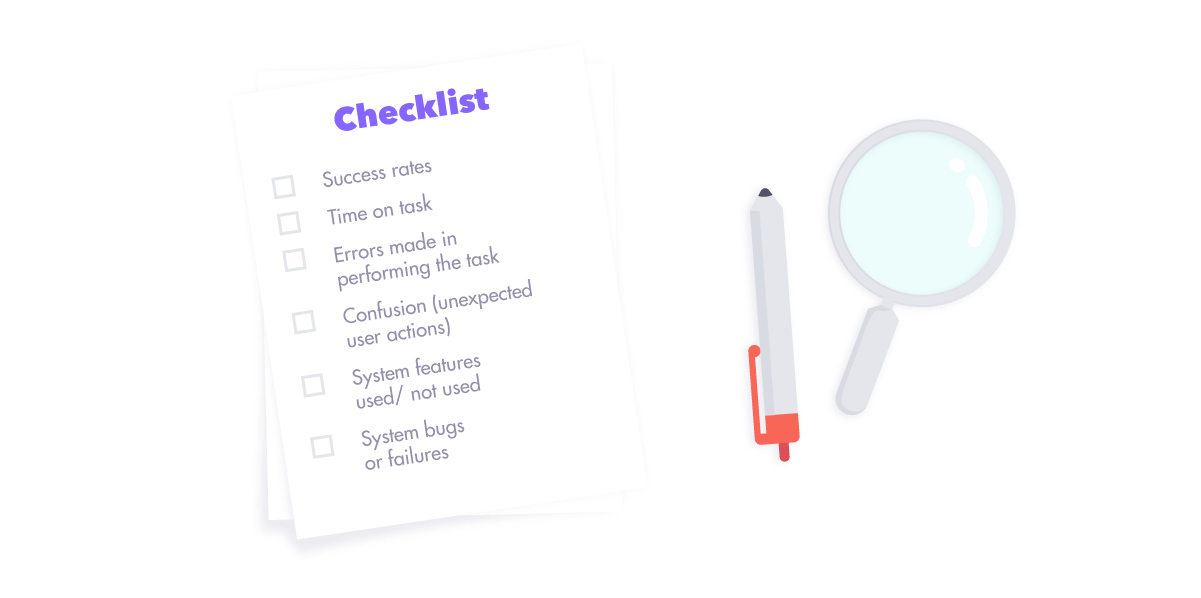
- Success rates
- Time on task
- Errors made in performing the task
- Confusion(unexpected user actions)
- System features used / not used
- System bugs or failures
During the test
- Record techniques and search patterns participants employ when attempting to work through a difficulty, for recording we can use software like ScreenFlow or silverback (mac only) of user testing.
- If participants are thinking aloud, record assumptions and inferences being made.
- Do not interrupt participants unless absolutely necessary
- If participants need help, provide some responses-
Provide encouragement or hint
Give general hints before specific hints
Record the number of hints given
- Watch carefully for the signs of stress in participants-
Sitting for a long time doing nothing
Blaming themselves for the problems
Flipping through documentation without really reading them
- Provide short breaks when needed
- Maintain a positive attitude for user experience, no matter what happens
- Use a monotone tonality with users i.e. never let users know that you are super excited or your body language indicate them that they are doing bad and things like that of usability testing.
- In case users ask questions to try to get your consent if they are doing it right never give them direct answers instead use words like “Okay, uh huh”. Instead, ask reverse questions like “Is it what you were looking for”
- Let them struggle and don’t over moderate